
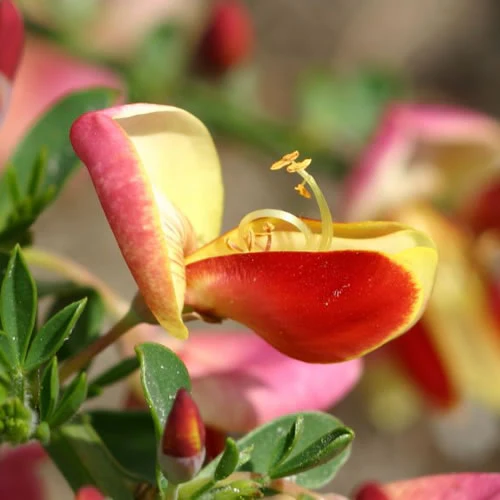
Cytisus 'Goldfinch'
The “Goldfinch” is an evergreen perennial. It is tolerant of many soil types and can grow in poor soil areas, however it prefers sunny areas only. In older plants the narrow and short green leaves may be noticeably reduced in number.
The blooms on this plant are of a pea-shaped variety and the colours are spectacular. Depending on the amount of sun and warmer weather, they most frequently arrive in the months of April and May. Two keel petals with red sides and yellow tips are enclosed by two outer petals with vibrant pinks and crimson reds.
Like other similar Cytisus plants, it should be cut back after flowering, with anywhere from 20% to 50% of the new growth removed in order to encourage vigorous blooming the following season.
They are a favorite of some of the pollinators like bees and butterflies. And they are mostly disease and pest free.
This shrub offers a shorter, but bushy growth and thus are good to use in areas where a lower canopy is desired.
Once established, they can survive in drought conditions and most soil types. For this reason, they are good to plant as landscaping accents in open cottage settings and other areas where landscaping accents are required.
Product Information
Product Information
Shipping & Returns
Shipping & Returns
Description
The “Goldfinch” is an evergreen perennial. It is tolerant of many soil types and can grow in poor soil areas, however it prefers sunny areas only. In older plants the narrow and short green leaves may be noticeably reduced in number.
The blooms on this plant are of a pea-shaped variety and the colours are spectacular. Depending on the amount of sun and warmer weather, they most frequently arrive in the months of April and May. Two keel petals with red sides and yellow tips are enclosed by two outer petals with vibrant pinks and crimson reds.
Like other similar Cytisus plants, it should be cut back after flowering, with anywhere from 20% to 50% of the new growth removed in order to encourage vigorous blooming the following season.
They are a favorite of some of the pollinators like bees and butterflies. And they are mostly disease and pest free.
This shrub offers a shorter, but bushy growth and thus are good to use in areas where a lower canopy is desired.
Once established, they can survive in drought conditions and most soil types. For this reason, they are good to plant as landscaping accents in open cottage settings and other areas where landscaping accents are required.